Tuesday, 27 January 2026


Module One


   STRATEGIC INTRAPRENEURSHIP.


Meaning of Strategic Intrapreneurship?


Strategic intrapreneurship refers to the practice of applying entrepreneurial skills, innovation, and strategic thinking within an existing organization to drive growth, improve operations, or create new opportunities. Unlike traditional entrepreneurs who start new businesses, intrapreneurs work within a company to introduce change and spearhead projects that add value. They think like business owners, but they operate with the resources and structure of an established organization. You must know that the concept of intrapreneurship involves identifying gaps, anticipating trends, taking calculated risks, and developing innovative solutions that align with the organization’s long-term goals. Just a gentle emphasis, Strategic intrapreneurs are proactive, self-motivated, and committed to the making a meaningful impact from within.


Importance of Strategic Intrapreneurship.

1. Drives Innovation: Intrapreneurs bring fresh ideas and solutions. It is one thing to develop an idea, it is another thing to implement the idea. So when you hear driving innovation, I just want you to know that strategic intrapreneurs help companies stay competitive in an ever-changing market.

2. Improves Organizational Growth: Strategic intrapreneurship helps

businesses expand their reach and services, enter new markets, and adapt to change efficiently.

3. Enhances Problem-Solving: Intrapreneurs are problem solvers. They often tackle internal challenges and the good part is that they do so with innovative approaches, which in return improve the overall productivity.


4. Builds a Resilient Culture: Organizations that foster intrapreneurship

become more agile and resilient. They are better equipped to face uncertainties.


Module Two

VALUE CREATION WITHIN AN ORGANIZATION


Value creation refers to the process by which an organization produces goods or services that are perceived as valuable by its customers, stakeholders, and society. This value can be tangible (like products) or intangible (like brand reputation).


To put it simply, value creation means improving something to make it more beneficial for everyone involved. In a business context, this is about providing products or services that meet customer needs while also ensuring profitability for the organization. When companies create value effectively, they not only satisfy their clients but also enhance their own success in the marketplace.


Strategies for Value Creation


1. Innovation:

Innovation means introducing new ideas, new products, or processes that meet customer needs.Organizations can foster an innovative culture by encouraging employee creativity, investing in research and development, and staying informed about industry trends.


2. Customer Experience Enhancement

  Improving how customers interact with the organization through better service, support, and engagement.Collecting customer feedback regularly can help organizations understand pain points. Training staff in customer service skills and using technology like CRM systems can also improve experience.


3. Cost Efficiency

Many persons do do know that cost efficiency is a strategy in value creation. But when you embrace this strategy,ensure you reduce operational costs without compromising quality.Organizations can streamline processes, eliminate waste, and adopt automation technologies. Regularly auditing expenses can identify areas for cost savings.


4. Partnerships and Collaborations

Establishing relationships with other organizations to combine strengths is key. When you hear a tree cannot make a forest, it applies to businesses too. So, it is not a bad idea to form strategic alliances or joint ventures with complementary businesses. These partnerships can lead to shared resources, expanded market reach, and innovative solutions.


5. Skill Development and Employee Engagement

As a leader in the business world, salary is not just the focus. Please invest in your workforce. This will improve skills and job satisfaction, It will lead lead to higher productivity. So when you offer training programs, career development opportunities, and foster a positive workplace culture, it can enhance employee engagement and decrease turnover.


Module Three & Four

IDEATION, LEADERSHIP AND FOLLOWERSHIP  IN INTRAPRENEURSHIP


Ideation in Intrapreneurship


Ideation is the creative process of generating and developing new ideas within an organization. Intrapreneurship leverages ideation to bring innovative solutions to life, often leading to new products, services, or processes.


Types of Ideation

1. Individual Ideation: Individual Ideation involves brainstorming ideas independently. Employees may come up with solutions based on their experiences and insights.

   - Example: A student in a tech company might independently develop an idea for a mobile banking feature that facilitates easier transactions for users.


2. Collaborative Ideation: This refers to group brainstorming sessions where team members build on each other's ideas.

   - Example: In a workshop, students from a Nigerian retail company gather to discuss ways to enhance customer experience. They collaborate to create a concept for an interactive shopping app.


3. Structured Ideation: This involves a systematic approach, often using frameworks or tools to guide brainstorming.

   - Example: A student-led initiative might use design thinking to develop a new product for local farmers, ensuring that the process is thorough and user-centered.


Leadership in Intrapreneurship


Leadership in intrapreneurship is about guiding teams towards innovation and fostering an environment where new ideas can flourish. Effective leaders inspire their teams, manage resources, and drive projects forward.


Types of Leadership:

1. Transformational Leadership: This type focuses on inspiring and motivating employees to innovate and exceed expectations.


2. Servant Leadership: This approach prioritizes the needs of team members, supporting them in their personal and professional growth.


3. Situational Leadership: Whenever you hear situational leadership, it is safe to mention adaptability. Any leader within this category must have adjusted his or her style based on the team's needs and the context of the project.


Followership in Intrapreneurship


Followership is the ability of individuals to support and engage with leadership. Effective followership is crucial for the success of any initiative, as it empowers teams to collaborate and bring ideas to fruition.


Types of Followership

1. Isolates: These are disengaged members who do not contribute to the team’s efforts.

   - Example: An employee who does not participate in team discussions or feedback sessions.


2. Bystanders: They observe but do not actively engage or contribute.

   - Example: A student who attends meetings but doesn’t voice opinions or participate in discussions.


3. Participants: These individuals are actively involved and contribute to the team’s objectives.

   - Example: A student who actively shares ideas and assists in developing projects.


4. Activists: They are highly engaged and willing to advocate for the leader’s vision.

   - Example: A passionate team member who rallies others to support a new initiative.


5. Diehards: These followers are deeply committed and will go to great lengths to support the leader's vision.

   - Example: An employee who dedicates extra hours to ensure a project’s success.


The Interplay Between Leadership and Followership


The relationship between leadership and followership is symbiotic. Every effective leaders rely on active and engaged followers to implement their vision, while followers need strong leaders to provide direction and motivation. 

So, how does leadership, followership concerns strategic intrpreneurship?

You must know that strategic intrapreneurship requires a combination of innovation, collaboration, and a balance between leadership and followership to drive meaningful change within an organization.


So, in a nutshell,  Strategic intrapreneurship is a dynamic process that hinges on ideation, effective leadership, and engaged followership. When  an environment of innovation and collaboration is encouraged, organizations can harness the collective strengths of their teams, hence ensure that both leaders and followers play essential roles in driving successful initiatives. To all the students that have listen to this lecture, please note that understanding these dynamics will be crucial as you embark on your careers in intrapreneurship.


Wednesday, 18 November 2015

                                             TEXTUAL SCHOLARSHIP
With Reference to Leah S. Marcus
Textual scholarship is basically the study of manuscripts or any printed work in order to find the original form of a text. It is more than just criticism because it covers a wide range of ‘describing’, ‘discovering’, ‘transcribing’, ‘editing’, ‘glossing’, ‘annotating’ and ‘commenting’ on texts. One is said to be a textual scholar only when he/she acquire knowledge after reading a literary piece. Moreover, textual scholarship is an everyday practice, though informally by many people. Anybody who has detected a misprint in a book is a textual critic.
The very aim of textual scholarship is to verify all the evidences of authorship and the changes that took place in the course of editing and printing. Another aim of textual scholarship is to verify if those changes was as a result of errors, revision, censorship or even editorial intervention. And finally to investigate the texts. Textual scholars attempt to find why texts remain the way they are. In order to achieve this, textual scholars go back to the sources of the text.
Sources of text could be,
      Author’s intention: E.g. Robert Browning wrote his works and the publisher says that there are lots of spelling errors thus they denied the readers the ability to see and read the original text of the writer.
       Collaborative intention: i.e. between the author and the editors. Authors’ editors do both linguistics editing and substantive editing (content). They improve format, structure, grammar, style, flow and even accuracy.
       Editorial Interventions: Editorial intervention is done by editors mostly to suit their publishing taste. For example, John Donne, a Catholic Priest wrote Holy Sonnet and love poetry. Later he burnt all his manuscript thus the possibility that what we read as Donne’s works might not be the original or preplanned work. The effect of this editorial intervention is that it tamper with the original meaning. The works of ee cummings are better understood the way he intended it to be since he (cummings) violated all the rules of punctuation.
HISTORY OF TEXTUAL SCHOLARSHIP
The history of textual scholarship will be considered in the following centuries;
560 - 527 BCE
Textual scholarship within this period are known for their rivalry between early libraries of Alexandria and Pergamum.
New philology.
14th CENTURY: RENAISSANCE
Textual scholarship within this period are known for their rediscovery of numerous texts from the Greek and Roman and the compilation of major religious texts like the Hebrew; Christian Bibles, and to some extent the Qur’an was questionable by this early textual scholars. For example, they believe that Erasmus who did so much to establish the text of the Greek Bible on humanistic philological principles might have forged at least one document.
17th – 18th CENTURY:
Textual scholarship gradually became regularized.
19th – 20th CENTURY:
Textual scholarship within this period underwent radical change in The new bibliography.

          In summation, textual scholars tends to question literary works that are published posthumously hence wants to know the original intention of the writer in relation with the published text (Editorial intervention).  

Thursday, 5 November 2015

BRIEF ANALYTICAL APPROACH TO HOUSE OF PRAYER BY WILLIAM COWPER
Stanza 1:

Thy mansion is the Christian's heart,
O Lord, Thy dwelling place secure!
Bid the unruly throng depart,
And leave the consecrated door.

Man’s heart is the dwelling place of God, hence the poet pleads on the Lord to take away anything that will corrupt the heart and keep the things that will help the heart.
Stanza 2:

Devoted as it is to Thee,
A thievish swarm frequents the place,
They steal away my hopes from me,
And rob my Saviour of His praise.

The heart is devoted to the Lord though the devil do visit to steal away God’s place in man’s heart.
Stanza 3-4:

There, too, a sharp designing trade
Sin, Satan, and the World maintain;
Nor cease to press me, and persuade
To part with ease, and purchase pain.

I know them, and I hate their din;
And weary of the bustling crowd;
But while their voice is heard within,
I cannot serve Thee as I would.

The poet was specific in mentioning those things that intrude the peace of his heart such as (1) Sin (2) Satan (3) The World

“There, too, a sharp designing trade
Sin, Satan, and the World maintain”

The above line can be compared to John Bunyan confession in Grace Abounding to the Chief of Sinner, “I was tempted to part from Christ; to exchange Him for the things of this world…” Sin was brought by Satan into the world to capitalize on the ignorance of man which will bring about destruction. The poet believes that Sin, Satan and the World never cease to persuade him to patronize their product hence the poet develop hatred for the devil. He finalizes the fourth stanza by out pouring his anger on these things that are like mountains toward his sweet fellowship with God.
Stanza 5:

Oh! for the joy thy presence gives,
What peace shall reign when Thou art there;
Thy presence makes this den of thieves
A calm delightful house of prayer.
 
The poet boast of the product of God’s presence in his heart saying that it brings 
(1) Peace (2) God’s presence turns his heart to a heart of prayer.
Stanza 6:

And if Thou make Thy temple shine,
Yet self-abased, will I adore;
The gold and silver are not mine;
I give Thee waht was Thine before.

The poet promise to give back to God what belongs to Him, if God will take care of his heart.


BRIEF ANALYSIS ON LANGUAGE, CULTURE AND SOCIETY WITH REFERENCE TO DORRIS SOMMER
Language is more than just a means of communication. On a practical level, language deals with sounds, symbols and gestures that a community puts in order and associates so that they can communicate. On a deeper level, language is an expression of who we are as individuals, communities, and nation. Culture refers to dynamic social systems and shared pattern of behavior, beliefs, knowledge, attitudes and values. Culture provides the environment in which languages develop, even as it influences how they are used and interpreted. For example, in many European cultures, a “good day” is a sunny day, while in many African cultures a “good day” is a rainy day. Different culturally shared values provide the context for interpreting the term for “good”
The term language, culture and society goes hand in hand because society cannot reveal itself to the world without its culture, even with culture, language play a central role hence, expressing culture.


According to a British Anthropologist Edward Tylor Hall, to understand a culture, one need to see it in a cross cultural context and by doing so, we will come to realize that the way our compatriot sees other culture is not universal. Edward rightly explain “culture is as complex”. This complexity here involve arts, customs, knowledge, belief and other habits acquired by man as a member of the society. Contemporary cultural anthropologist categorized culture into four basic features:
. Culture is a social inheritance and not a biological heritage
. Culture cannot be pocketed by one person, it belongs to the society
. Culture is a symbolic meaning system in which language is one of the important ones.
. Culture is a unified system.
Today we are studying English Literature. That Literature according to Humanist is the reflection of life, so studying English literature is like learning the life of a particular society. Post structuralism believes that work are inspired based upon the other, hence literature can have no singular meaning. English does belong to the British, but to the world.
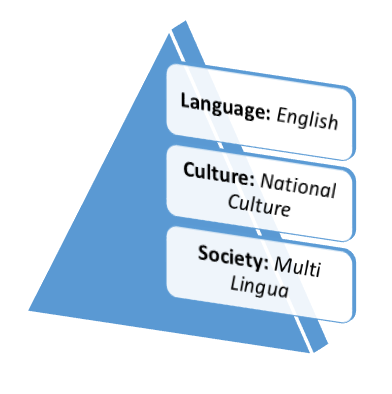
According to Doris Sommer, we are entering into a new culture i.e. national culture. To be part of this culture, one need a national identity known as English. Doris S. believes that in this fast developing world, a multi-lingua society has better advantage than a mono-lingua society due to its political stability and emotional richness. In order to be part of this multi-lingua society, Sommer urges everyone not to preserve their culture, as she rightly put it “Throughout this country and many others, monolingualism is losing its descriptive power for literary and cultural studies.” Unlike the ancient times, when a person is seen as a suspect if he/she knows more than one language and culture. This era propel everyone to be bi-linguist and every society to be multi-cultural.
          Conclusively, language is the primary vehicle that hybridize Asian culture, African culture, Caribbean culture, European culture etc. it is only when these cultures have being conglomerated, then we can boldly agree that the world is now in one:


TOPIC: RICHARD SHERIDAN’S IDEA ON DISGUISE IN SCHOOL FOR SCANDAL VS SHAKESPEARE’S IDEA ON DISGUISE IN TWELFTH NIGHT

AN INTRODUCTION TO RICHARD SHERIDAN
                Giving the invention of anti-sentimental comedy which was a direct response to sentimental comedy. Richard Brinsley Sheridan stand tall to erase the popular comedy of the 18th century. Anti-sentimental comedy was totally different from sentimental comedy because of its usage of cynicism to comedy achieve its message. Instead of tears, sorrows, the audience can now laugh at end of a play.

CHARACTERISTICS OF ANTI-SENTIMENTAL COMEDY
1)      Farce and disguise
2)      Satirical comedy and irony
3)      Marriage for love and marriage for money
4)      Wit of language and verbal dialogue
5)      Emotions have boundaries
6)      Amusing intrigues and situations
Undoubtedly, Sheridan’s purpose of writing both “The Rivals” and “School of Scandal” was to entertain the audience by making them laugh and not to shed tears

AN INTRODUCTION TO WILLIAM SHAKESPEARE
                William Shakespeare is a unique writer who has such a rare power to probe even the hidden spots of the human soul. Inspite of having such a skill he cares to make reality present in all his works. He has an easy entry to every human emotion or knowledge of undiscovered science about human life. No corner in life escapes his investigation to such an extent that shows “Universality of his interest”. It is universally known that he owns an ability to deep understanding of human sense and hunting the intimate moment in life as if he lives this era himself. Not only this, he excels in injecting interests as well as suspense in every item he tackles and this is the key to his talent. He re-tells the historical or the old legend with a unique suspense as if they were told for the first time.

                One of the important and repeated themes in Shakespeare’s play is disguise. Due to frequency, this device is in need for new investigation and probing not to trace disguise itself, but to reveal the excuses behind its influence on the person himself and the surrounding people. It is important to learn that disguise does not always require the changes in the dress or wearing a different mask, but changing behaviours can achieve the similar aim.


There is a diagram, disguise divided into two Viola/ Cesario (Shakespeare) and Sir Oliver/ Premium/ Mr. Stanley (Sheridan)

WHY DISGUISE OR CHANGE OF APPEARANCE?

A)     To Shakespeare, disguise was the core opportunity for Viola to be with Duke Orsino. Viola was compelled to disguise herself as Caserio, the pageboy. The connecting factor between Duke Orsino and Viola after the shipwrecked was the disguise, hence both could stay under same roof.
To Sheridan, disguise was also an opportunity for Sir Oliver to interact with Joseph and Charles Surface. With the help of Rowley, who plotted with Sir Oliver to unveil the true characters of both brothers.
B)      Shakespeare uses disguise to accomplish his trilateral love project


Without Cesario, Twelfth Night would have been a bilateral love play, but Shakespeare having a big picture in mind, knew that Viola as a single character cannot add flavor to his three-sided love project, hence introduces Cesario as the fourth character in the appellation of disguise.                                                          
To Sheridan, disguise was the tool to measure love.
WHO: Between Joseph Surface and Charles Surface, who love Sir Oliver more is the question? How to achieve this objective is another question. Sir Oliver appearing to Charles Surface as Premium a money lender but with the intention of knowing Charles’ definition of love. Sir liver appearing to Joseph Surface as a poor man was also to know Joseph’s definition of love
HOW: The gravity of love was revealed in Act 111 scene 1, Charles on the verge of selling some of the family portrait to Mr. Premium (the disguised Sir Oliver). Sir Oliver or Premium was keen to bargain for one portrait which have been passed over and over, but what was Charles’ response?
CHARLES: “No, hang it! I’ll not part with poor Noll. The old fellow has been very good to me and egad, I’ll keep his picture while I’ve a room to put it in”
Even when Mr. Premium gave Charles an offer to pay more for that portrait, Charles still replied
CHARLES: “Don’t tease me, master broker; I tell you I’ll not part with it, and there’s an end of it”
Mr. Premium was amazed at Charles’ reply hence called him “An honest fellow”
Charles justified his love for Sir Oliver by not selling that portrait and by giving money to Rowley to give to old Stanley (Stanley is the disguise of Sir Oliver), hence, Moses termed Charles to be “damned Charitable”.
Joseph Surface on the hand justified his love for Sir Oliver in Act 1V Scene 1
JOSEPH: “My dear Sir… you are strangely misinformed… Sir Oliver is a worthy man, a worthy man… a very worthy sort of man… but avarice. Mr. Stanley is the Vice of age… I will tell you my good Sir in confidence… what he has done for me has been a mere… nothing tho’ people I know have thought otherwise and for my part I never chose to contradict the report”
Joseph demed any help from Sir Oliver and went on defending himself by telling Mr. Stanley how he borrowed his brother’s money.
Joseph deemed any help from Sir Oliver and went on defending himself by telling Mr. Stanley how he borrowed his brother money.


Joseph and Charles defined love to their uncle in two different ways which shows:

WHY THEY LOVE SIR OLIVER

1)      Joseph define his love for Sir Oliver as a love that show forth itself as blood related not because he really love Sir Oliver. Aside blood being the link between Joseph and Sir Oliver, Joseph have no genuine love for Sir Oliver, hence the use of disguise by Sheridan was successful to define Agape love.
2)      Charles define his love for Sir Oliver as a natural love. Charles love Sir Oliver for being his uncle, he loves him for taking care of him and for his generosity.

A)     Both Shakespeare and Sheridan uses disguise to hide the identity of a character which involves a change of appellation.
Viola        --- Cesario (Two different names)
Sir Oliver --- Premium and also to Stanley (Three different names)
B)      Disguise as a tool of deception
          Disguise simply means to change the appearance or guise of oneself so as to conceal identity or mislead, as by means of deceptive garb
Deception came from its latin root “decipere” which means to deceive. Deception is defined as an instance of actions or schemes fabricated to mislead or delude someone into errantly believing lie or inaccuracy. Disguise as a tool of deception simply means disguise used to mislead or deceive someone.
Deception in this context will be divided into four;
1)      Lies: Making up information or giving information that is the opposite or very different from the truth.
Lie is a principal ingredient to a successful disguise. As in most comedies, William Shakespeare’s Twelfth Night extensively uses disguises to add to the comical nature of the play. Without lie as an important element, the action in the play would slow dramatically, hence making the story less intriguing and less interesting. To Sheridan, the way salt is to the food that is how lie is to his disguise. It is fair to say that Shakespeare disguises Viola to a single character Caserio and hard to believe that Sheridan disguises Sir Oliver to a bilateral character hence Premium and Stanley.

2)      Equivocations: Making an indirect, ambiguous or contradictory statement. Sir Oliver uses indirect statement while conversion with Joseph Surface.
“What! ... has he never transmitted you Bullion… Rupees… Pagodas!” Sir Oliver knows the truth but force words from Joseph, Joseph on the other hand never wanted to help Mr. Stanley, so on that note he lied, saying
“O Dear Sir… Nothing of the kind… no…no… “

3)      Concealments: Omitting information that is important that is important or relevant to the given context or engaging in behavior that helps hide relevant information.
Both Shakespeare and Sheridan made use of concealment to efficaciously carry out their disguise concept.
SIR OLIVER: “… But there is one portrait which you have always passed over.”
SIR OLIVER: “… I’ll give you as much for that as for all the rest.”
Man is wired in such a way that he can easily compromise that is why man sometimes cannot resist some temptation that comes their way. The statement used by Sir Oliver can be considered as a tempting statement, paying for Sir Oliver’s portrait higher than any of the portraits is tempting. If Charles had agree to it, it would have been as a result of pressure from Sir Oliver.
                The confusion that Sebastian creates when he returns would not occur without the disguised Viola. Even more disorder is created when Olivia who Orsino is hopelessly in love with falls for Caesario who is secretly in love with Orsino. Orsino needs Caesario to express his affection for Olivia, which Caesorio/ Viola is not thrilled with. As she puts it:
“whoe’er I woo, myself would be his wife.”

WAS DISGUISE THE ANSWER TO SHAKESPEARE AND SHERIDAN’S QUEST?
                The answer will be Yes because Sir Oliver in School of Scandal disguising to Premium a money lender and Stanley a beggar was the true reason he was able to discover among Joseph and Charles who truly love him, hence he gave his wills Charles Surface.
SUMMATION
                Viola’s disguise and the resulting chaos, are basically the most important elements of the plot of the play and are crucial to the development of the plot. Without Premium and Mr. Stanley, there would be little excitement or intrigue and Sheridan or Shakespeare would not be able to thoroughly reflect his views of humanity.